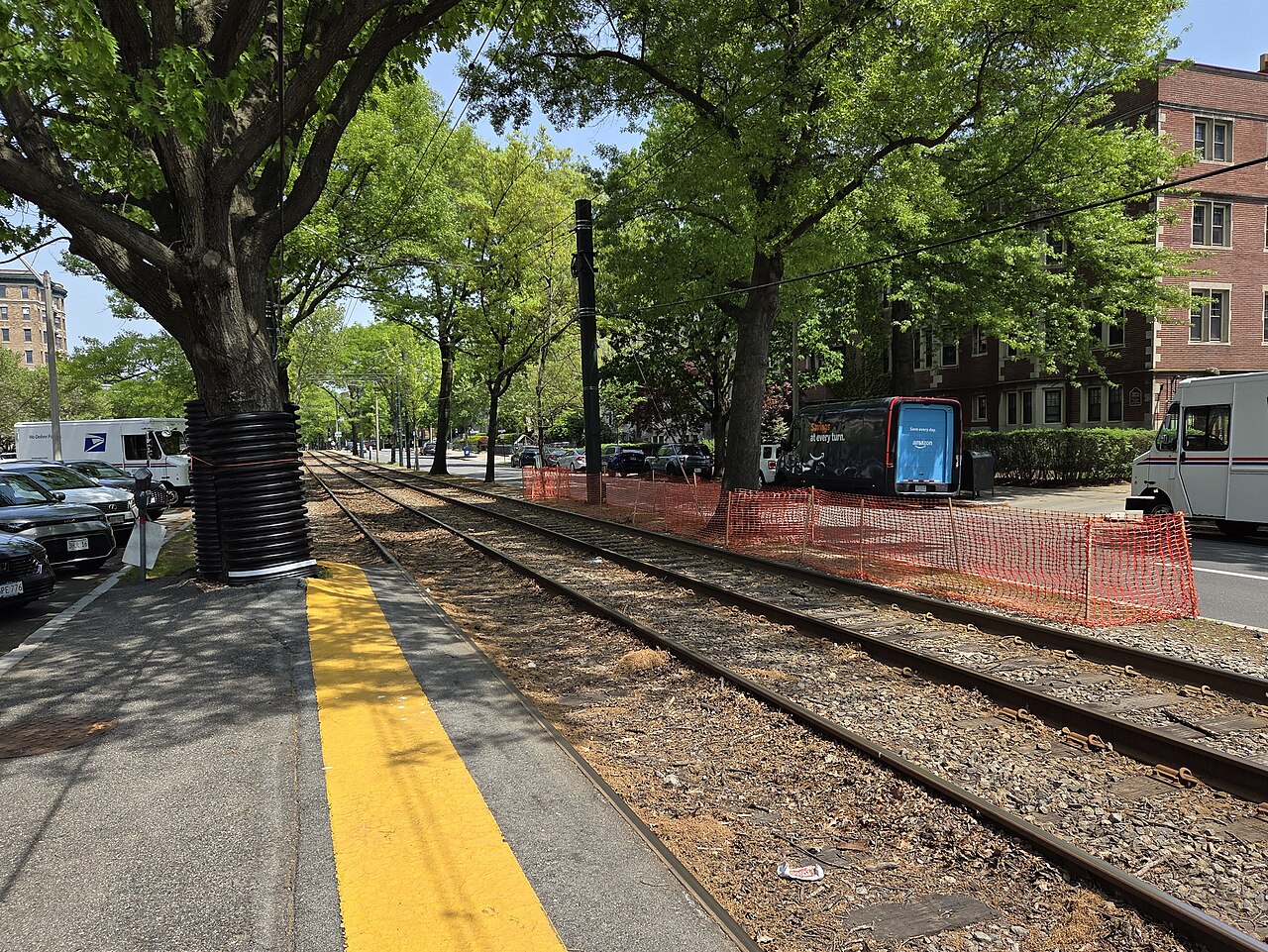
Tree protection during construction at Saint Paul Street station, Massachusetts. Illustrative photograph.
Photo: Pi.1415926535 / Wikimedia Commons · CC BY-SA 4.0 · Reduced-size version; display cropped to fit.

A pre-construction tree survey documents the trees a project may affect and provides the information needed to make a preservation plan. The useful result is more than a list of trunks. It connects the trees on the property with the excavation, grading, utilities and access shown on the construction plans.
If you are planning an addition, a pool, a new driveway or a larger development, the best time to ask about trees is while the design can still change. A tree that sits outside the building footprint may still have roots inside the work area.
When should the arborist get involved?
Bring the arborist in before the layout and construction methods are fixed. At that stage, the owner and design team can compare realistic choices: adjust a driveway, relocate a utility route, change an access path or reconsider which trees can remain.
A later inspection can still be useful. It may identify conflicts and help reduce impacts. But an arborist cannot restore the choices that disappeared when a foundation was excavated or a trench was dug.
For a useful first visit, provide the property survey, current site plan, proposed grades and any known utility work. A sketch is better than no plan, as long as everyone understands what is still undecided. Tell me about temporary work too. Equipment access and material storage can matter as much as the finished structure.
What gets recorded during the survey?
The inventory should identify the trees clearly enough that the owner, designer and contractor are discussing the same tree. Depending on the assignment, that can include numbered tags, mapped locations, species, trunk measurements, condition observations and photographs.
I also look at context. Is the tree growing beside an existing retaining wall? Has its root area already been disturbed? Is the proposed work on one side or several? Will drainage change? Which trees function as a group?
The level of mapping and measurement should match the project. An arborist’s tree inventory does not automatically replace a boundary or engineering survey. If precise locations will determine a foundation setback, the tree information needs to be coordinated with the appropriate survey professional.
Does the survey say which trees can be kept?
It should support that decision, with the limits made clear. A preservation recommendation considers the tree’s condition, the proposed disturbance, species response and the future site. A tree can be attractive today yet poorly suited to the proposed changes. Another may be retainable if the project changes around it.
The report should distinguish what is observed from what is assumed. If the grading plan is unfinished or the utility route is unknown, the preservation assessment is conditional on those missing details. Keeping a tree on a drawing is not a promise it will survive construction.
How is a tree protection zone established?
The protection zone should be established for the actual tree and site, then shown clearly on the plans. Trunk size is useful, but a single radius formula is not a universal answer. Existing roots, age, condition, species, soil, prior disturbance and the kind of proposed work also matter.
Where a preferred zone conflicts with the project, the discussion should identify the impact and compare alternatives. Reducing the fenced area does not make the underlying risk disappear. Any specified adjustment needs a reason, appropriate construction methods and an understood limitation.
The fence also needs instructions. Workers should know what may not happen inside it, who can approve a change and what to do if unexpected roots or conflicts appear.
What should the contractor receive?
A useful protection plan gives the contractor requirements that can be located, understood and followed. Typical subjects include protective barriers, access and staging, restrictions on excavation and storage, utility installation, drainage and the procedure for reporting damage or requesting a change.
The plan should fit the actual work sequence. A fence installed after demolition misses an important part of the job. A protected tree can also be injured during final landscaping if the restrictions quietly disappear when the building is finished.
Monitoring should be included in the scope when the project needs it. A site visit at a critical excavation stage can document whether conditions match the plan and whether a new decision is needed.
Which Kansas City-area cities require tree documentation before construction?
Several local cities require tree documentation for particular projects. The document may be a tree survey, preservation plan or Tree Protection and Removal Plan. An inventory supplies the tree information; the plan also identifies removals, retained trees and protection measures.
- Overland Park and Lenexa: Both explicitly require tree surveys within particular development-review processes. The zoning, application stage and available exceptions matter. See the Overland Park survey provision and Lenexa documentation requirements.
- Mission Hills: Specified construction and demolition projects trigger tree-protection provisions. A required plan identifies existing trees, their sizes and species, removals and protection measures. Protected-tree removals can also require replacement based on size and location. See the Mission Hills requirements and exceptions.
- Prairie Village: The rules cover certain development projects and, in R-1A and R-1B districts, new homes, teardowns and specified substantial remodels. Applicable projects may require a tree protection/removal plan and mitigation for covered removals. See the Prairie Village project triggers.
- Mission: The plan provision covers new commercial or significant residential projects that meet its tree-related criteria. Replacement requirements, exceptions and a conditional fee option also appear in the code. See the Mission requirements and limitations.
These are examples, not a complete metro list. The city tree-requirements guide covers 12 selected Kansas and Missouri cities and provides the official sources and the date each was checked. Confirm the requirements for your specific property and project before clearing or demolition.
An arborist’s report and a required landscape or engineering plan are not automatically interchangeable. Confirm who must prepare each document and what the reviewing authority expects before commissioning the work. Even when a survey is not required, it can help you make a better decision about trees you want to retain.
Where should I start?
Send the property location, a description of the project and the plans you have. I can help define whether you need a preliminary site opinion, a tree inventory, a construction impact assessment or a more detailed protection and monitoring scope.
Learn about pre-construction tree consulting, or request a consultation.
References
International Society of Arboriculture, Best Management Practices: Managing Trees During Site Development and Construction, third edition, 2023. See also ISA’s public guide to avoiding tree damage during construction.
Have a tree question of your own?
If something in your yard, your case, or your project needs a clear, independent answer, let’s talk it through. No pressure, no commitment.