Your tree doesn’t need that.
What to ask before agreeing to pruning, treatment or removal.
Good tree care protects more than a tree.
You want to take care of your trees. Someone recommends “thinning” the canopy, renewing an annual canopy spray program, or removing a tree near the house. You approve the work because an arborist recommended it.
Before you agree, ask what your tree needs and how the proposed work will meet that need. A clear answer can protect your money, your property and the tree that helps make your yard feel like home.
In my consulting practice, I assess before acting, preserve where feasible, consider safety, and think beyond the next visit. Sometimes the right response is pruning or treatment. Sometimes it is improving the growing conditions, monitoring a concern, or leaving part of the tree alone.
01 · Pruning
Does my tree need pruning?
“Clean it out” sounds helpful. It tells you little about the problem, the branches involved, or the amount of living canopy someone plans to remove. ISA’s homeowner guidance makes the distinction clear: routine thinning does not necessarily improve tree health, and removing foliage can reduce the tree’s growth and energy reserves. [1]
Start with the objective. Are branches touching the roof? Is a particular limb damaged? Does a large, dead branch hang over a place you use? Ask the arborist to walk to the tree and show you the concern.
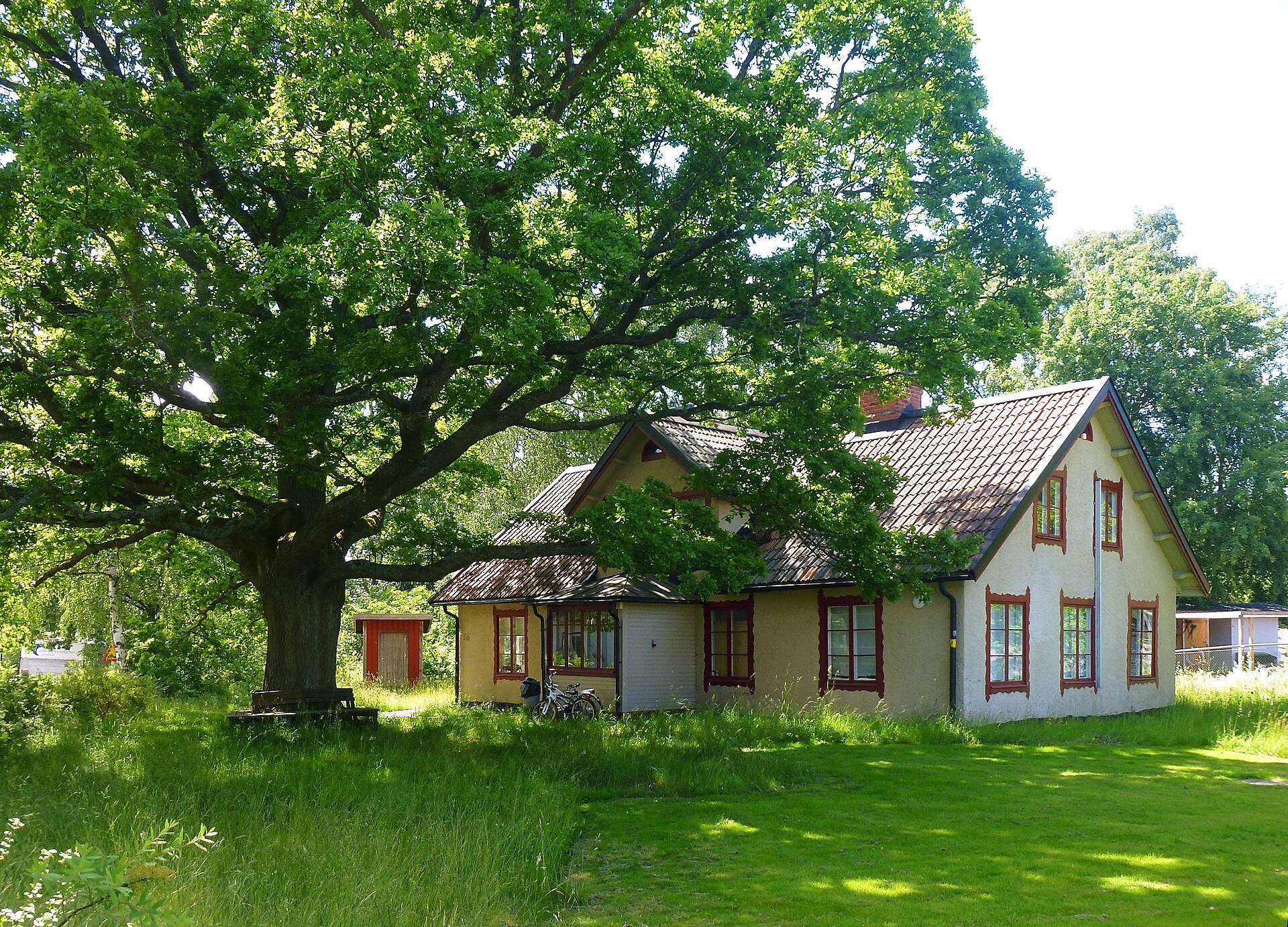

Keep the architecture when the objective allows it.
A large scaffold limb (a branch growing directly out of the trunk) is part of the tree’s established architecture. A reduction cut shortens a branch back to a suitable living lateral. That can provide an alternative to removing the entire limb where the structure, tree condition and objective support it.
For suitable mature trees, I prefer small reduction cuts toward the outer third of branches, under two inches in diameter wherever feasible, while retaining useful interior foliage. I make that choice after looking at the species, condition and pruning objective. Ask about the amount of foliage coming off as well as the size of each cut.
Give deadwood pruning a purpose.
Focus on dead branches that could injure someone or damage property. Ask which branches present the concern and what removal threshold the crew will use. Suitable retained deadwood can provide habitat; a completely twig-free crown should not be the automatic goal.
Ask before agreeing
- What specific problem will this pruning solve? Or, what is likely to happen if we leave it alone?
- Which branches, what cuts, and how much living canopy will you remove?
- Could we meet the objective with less pruning or smaller wounds?
02 · Treatment
Does my tree need treatment?
I support treatment when there is a sound reason and evidence that it can work. I question automatic renewal of broad-spectrum insect or disease programs without a fresh look at the tree, the target and the result.
Ask whether the goal is tree health, appearance, nuisance reduction, or protection against a specific threat. Those are different decisions. You deserve to understand which one you are paying for.
Ask what the treatment can accomplish now.
Apple scab on an ornamental crabapple illustrates why timing matters. Fungicides protect susceptible leaves; they do not impact spots already on a leaf. Repeated severe early leaf loss can weaken a tree, so the history and severity matter when deciding whether protection is worthwhile. University of Minnesota Extension explains both the timing and the circumstances that can justify treatment. [2]
“I can spray that” is not enough. Ask what the product will accomplish at this stage, how the arborist will judge the result, and what would justify continuing next year.
Protect the insects helping in your garden.
Seeing an insect does not establish a need to eliminate it. This is actually contrary to the job of an arborist! Identify the organism and assess the injury before choosing a response. Ask what else the proposed treatment could harm.
Acephate is one ingredient worth asking about. The National Pesticide Information Center describes it as a broad-spectrum insecticide that is highly toxic to bees and other beneficial insects. Its systemic activity does not make the non-target question disappear. [3]
If the “pest” is mimosa webworm on honeylocust, its adult is a moth. The useful lesson for a homeowner is to consider the injury and the insects that help suppress the pest. Purdue warns that early-season use of long-lasting, broad-spectrum pesticides can lead to honeylocust spider mite problems later in the year. Protecting mite predators matters. [4]
Ask before agreeing
- What pest, disease or credible threat are we addressing, and how do you know?
- What is likely to happen if we don’t treat?
- Why this treatment, why now, and what else could it harm?
- Why renew this year, and when will we reassess?
03 · Removal
Does my tree need removal?
In my work, I have met homeowners who were ready to remove a tree because someone told them a dead branch, its size, its proximity to a house, or its lean made removal necessary. My assessment did not always support that conclusion.
One dead branch does not establish that the whole tree is dying. A large tree could cause serious damage if it struck a house, but that consequence does not tell you how likely failure and impact are. A longstanding lean needs a different conversation from a new or increasing lean.
Ask for an assessment, not a frightening adjective.
For a removal recommendation based on risk, ask for the specific finding, the part that could fail, what it could strike, the assessed likelihood and the time period. Ask about options for retaining the tree and the risk that would remain. ISA’s risk guidance explains why signs of possible defects need professional interpretation. [5]
Decay deserves that same interpretation. Trees compartmentalize injuries, damages and wounds, but that defense does not certify stability. A cavity is a reason to understand the tree’s condition and loading, rather than a verdict reached from the opening alone.
For an independent review, look for an experienced assessor with current ISA Tree Risk Assessment Qualification (TRAQ) credentials. Ask who benefits financially from the proposed work. An independent opinion can help you separate the assessment from the proposed work. Address genuine risks promptly.
Ask before agreeing
- What specific finding supports removing the whole tree?
- What part might fail, what could it hit, and how likely is that over what time period?
- What could we retain, and what would we need to change or monitor?
04 · Useful care
Give the tree better growing conditions.
You have useful work to do before a saw or sprayer enters the picture. Look at the soil, roots, water and planting depth. Consider soil compaction, construction disturbance and the conditions your tree has lived with for years.
Start as far out on the decline spiral as possible.
Manion’s decline spiral describes interacting pressures: predisposing factors that leave a tree vulnerable, inciting stresses such as drought or defoliation, and contributing agents that compound the decline. It is a model for understanding a combination of causes, not a fixed sequence for every tree problem. [6]
Predisposing factors
Longstanding soil, root or site limitations.
Inciting factors
A stress such as drought, root injury or defoliation.
Contributing factors
Additional pressures that compound the problem.
Before buying another treatment, ask what you can improve where the tree grows. Improving those conditions can support the tree while an arborist addresses a justified pest problem. Some pests can damage vigorous trees too; do not assume every infestation has a soil cause.
Spread mulch widely and taper it shallow.
Carefully replacing some turf with a wider organic mulch bed can protect the root zone. Protect surface roots during that conversion. Maintain a shallow wood-chip layer, generally two to four inches total away from the trunk, and make it shallower as you approach the root flare. Avoid piling mulch against the bark.
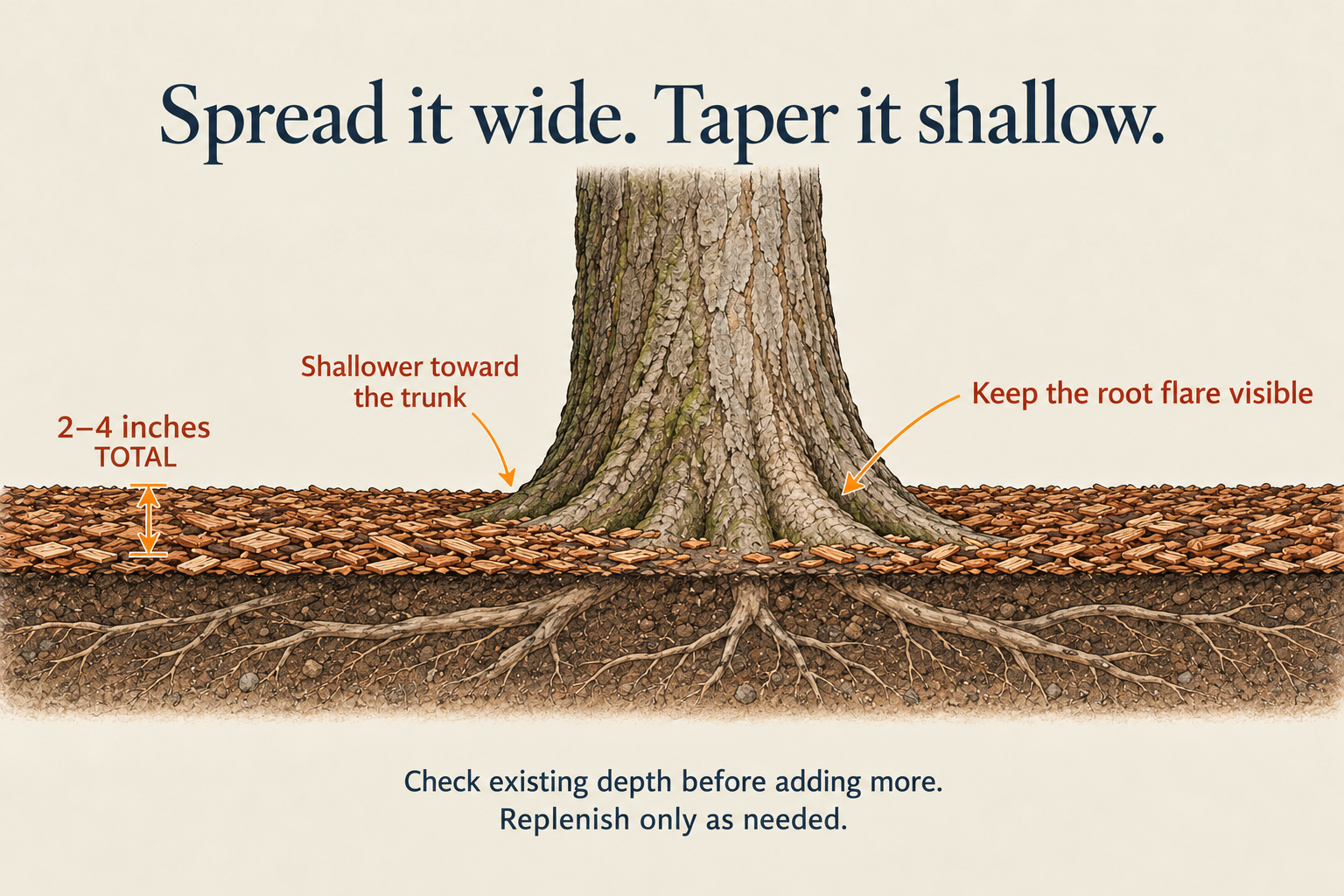
Keep the root flare visible. If the trunk enters the soil like a straight pole, ask an arborist about a buried collar, deep planting or stem-girdling roots. Inspection and excavation can be useful professional services; root cutting requires judgment about both health and stability. Johnson County’s mulch guidance and Missouri Extension’s root guidance explain these concerns. [7] [8]
Keep useful fall leaves in suitable tree and shrub beds, use compost where appropriate, and water according to soil moisture and the tree’s needs. Avoid thick leaf mats over turf or sensitive plants. A diagnosed leaf-borne disease may call for targeted sanitation rather than blanket leaf retention.
Consider what can remain as habitat.
A declining tree may still have a viable lower crown that a specialist can manage through a retrenchment plan. Suitable dead branches or a reduced standing dead trunk can support insects and wildlife. A standing dead tree is a snag; a hollow or cavity is one of its possible habitat features. Missouri’s conservation guidance explains their wildlife value. [9]
Ask what life you could keep. The decision needs a site-specific assessment and a plan for future change, not just the absence of immediate danger.
05 · In writing
Make the work clear before it starts.
A proposal that says “prune oak for roof clearance” leaves too much for the crew and homeowner to interpret. Ask for the intended branches, clearance objective, cut types, limits on wound size and foliage removal, timing and cleanup. Agree on what requires another conversation if the crew finds different conditions.
A useful scope identifies
- The tree and objective
- Which tree, which part, and what the work must accomplish.
- The cuts and limits
- What comes off, what stays, and the boundaries the crew must follow.
- The follow-through
- Timing, debris handling, outcome checks and reassessment.
The right numbers depend on the assessed tree. A written plan gives you and the crew something concrete to agree on before the work changes the tree.
Keep these questions
Before you say yes.
- What problem are we solving?
- What evidence supports the recommendation?
- What alternatives are appropriate, including monitoring?
- Exactly what work will be done, and what are its limits?
- How will we judge the result and decide when to reassess?
An independent opinion
Bring the tree into the conversation.
If you are weighing a recommendation, I can assess your tree and help you understand the options before you authorize work.
Ask about a consultationTyler Woodard
ISA Certified Arborist MW-6136A · TRAQ
Independent consulting arborist serving the Greater Kansas City Metro.
Sources & further reading
- ISA: Pruning Mature Trees. Pruning objectives, foliage removal and reduction.
- University of Minnesota Extension: Apple scab. Severity, repeated leaf loss and treatment timing.
- NPIC: Acephate General Fact Sheet. Mode of action and beneficial-insect toxicity; reviewed June 2011, not a current product-label reference.
- Purdue Extension: Mimosa Webworm. Identification, control and secondary mite concerns.
- ISA: Recognizing Tree Risk. Indicators that call for professional assessment.
- Forest Pathology: Declines of Trees. Manion’s model and interacting causes.
- Johnson County K-State Research and Extension: Mulch Volcanos.
- University of Missouri Extension: Pruning and Care of Shade Trees. Deep planting, stem-girdling roots and mature-root cutting concerns.
- Missouri Department of Conservation: Protecting Den Trees and Snags. Habitat concepts, applied here with site-specific urban risk management.
This article explains questions to ask and principles for decisions. An assessment of your tree and site determines the work. Chemical selection and use require the current label and a diagnosis.
Have a tree question of your own?
If something in your yard, your case, or your project needs a clear, independent answer, let’s talk it through. No pressure, no commitment.